 Charleston Mobile Home Leveling
Tie-Downs & Ground Anchors for Lowcountry Mobile Homes
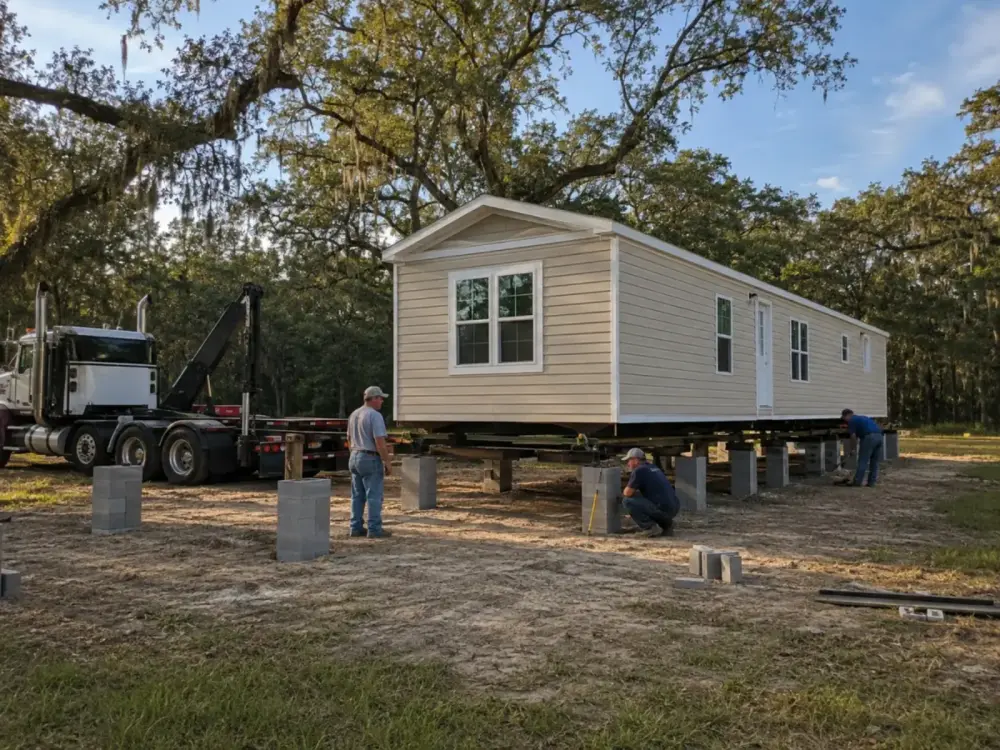
A manufactured home does not resist wind by being heavy. It resists wind by being tied to the ground. The anchoring system, steel anchors driven into the soil and connected by rated galvanized straps to the steel chassis above, is the entire uplift and overturning story, and it is the one component on the home that can fail completely without producing a single symptom you would notice from the kitchen. Full installs and retrofits run $600 to $3,500, replacements are quoted per anchor, and re-tensioning a sound system is inexpensive and comes with any relevel. The inspection is free.
What Wind Zone II means for a home here
This is not a regional generalization. The federal manufactured home construction standard, 24 CFR 3280.305(c)(2)(ii), lists the Wind Zone II counties by name, and the South Carolina entry reads: Beaufort, Berkeley, Charleston, Colleton, Dorchester, Georgetown, Horry, Jasper, and Williamsburg. Every other county in the state falls to Zone I. Your home is in Zone II because a federal regulation says the county is.
Zone II is designed against a 100 mph wind, Exposure C, and the same section sets the anchorage design loads: a net horizontal drag of 39 pounds per square foot and an uplift of 27 pounds per square foot. Those numbers are what the hardware under your home has to hold, and they are considerably higher than the Zone I figures that apply eighty miles inland.
South Carolina then writes its own rules on top. Regulation 79-42, under the Manufactured Housing Board, sets the installation standards, and the specifics are worth knowing as an owner because they are how you tell a real installation from a fast one:
- Anchor capacity. Every ground anchor must resist a working load of at least 3,150 pounds in the direction of the tie, plus a 50 percent overload of 4,725 pounds, without failing. The tie itself carries the same requirement, at no more than 2 percent elongation.
- What the tie connects to. Ties must run from the ground anchor to the main structural steel frame, the I-beam, and explicitly not to the outriggers. A strap fastened to an outrigger is fastened to a bracket, not to the home.
- How it connects. A five-eighths inch drop-forged closed-eye bolt through the I-beam web, with cable ends secured by at least three U-bolt clamps.
- Depth. Anchors must extend below the frost line and be installed to the full depth the anchor manufacturer specifies.
- Corrosion protection. Galvanizing of at least 0.30 ounces per square foot of zinc per side.
On tie counts, the honest answer is that it depends on which rule governs your home. A new home is installed to the manufacturer’s instructions, or to the federal installation standard at 24 CFR Part 3285 where those instructions are unavailable, and those commonly call for more hardware than the state minimum. For used homes without instructions, Regulation 79-42’s Zone II table sets the floor by length: a single-section home up to 46 feet needs 2 vertical and 4 diagonal ties, 49 to 58 feet needs 3 and 5, 58 to 70 feet needs 3 and 6, and 73 to 84 feet needs 4 vertical and 7 diagonal. Multi-section homes require diagonal ties only. Whichever rule applies to your home, the inspection counts what is actually installed against what should be there and puts both numbers on paper.
The work itself belongs to licensed installers. South Carolina Code § 40-29-30(A) states that no manufactured home installer may install manufactured housing without being licensed by the Board, and § 40-29-20(8) defines installing to include positioning, blocking, leveling, supporting, and tying down. On a system whose only job is to perform during a hurricane, that license is not administrative trivia. It is the whole point.
Why the coast carries the rating
Hugo is the reference event for this region. It came ashore near Sullivan’s Island just after midnight on September 22, 1989 as a Category 4, with sustained winds in the range of 135 to 140 mph. The storm tide at Bulls Bay near McClellanville reached roughly 20 feet, the highest ever recorded on the United States East Coast, and hurricane-force winds carried far inland through Berkeley County, flattening pine across the Francis Marion and around Moncks Corner. Manufactured homes that were not meaningfully tied to anything did not remain where they had been placed.
Andrew hit Florida three years later, and HUD revised manufactured-home wind standards in July 1994 in response. That date matters locally because a large share of the housing stock here predates it.
The inland detail is the one worth holding onto. Hugo felled over a billion board-feet of timber in the Francis Marion National Forest, around 70 percent of its lumber-quality trees, and ended major logging there permanently. That is fifty miles from the beach. Being inland is not the same as being out of it.
Since Hugo the region has taken serious but lesser hits: Matthew came ashore as a Category 1 just south of McClellanville inside Charleston County in October 2016, and Debby made a second landfall at Bulls Bay in August 2024, closing eastbound I-26 in Berkeley County and prompting around thirty water rescues near Moncks Corner. Glancing blows and near misses rather than another direct major landfall. That is comfortable, and it is also the exact condition under which anchor systems corrode and slacken for decades with nobody having a reason to look at them.
The four ways a good system goes bad
Settling takes the tension out. Straps were tightened against the home at the height it sat when they were installed. On this ground the home settles on a three to five year cycle, and every fraction of an inch of drop becomes slack somewhere in the system. A slack strap contributes almost nothing under load. This is the single reason leveling and tie-down work are one conversation rather than two, and why straps get re-tensioned as part of every relevel.
Steel in wet ground corrodes where you cannot see it. The shallow water table across this region keeps anchor shafts in damp soil more or less permanently, and the corrosion happens below grade. Nearer the harbor and the tidal rivers through North Charleston and Goose Creek, salt in the air works on strap hardware at the head as well. A strap can look sound where it meets the frame and be lace where it enters the ground.
Soft ground lets anchors walk. Repeated load cycling in saturated soil heaves and leans anchor heads over time. Short anchors installed without stabilizer plates, which should not have gone into this ground in the first place, are the ones that move first.
The home was anchored to an older rule, or barely anchored at all. Homes predating the 1994 revision were built and frequently anchored to a weaker standard than the zone calls for now, and there are a lot of them in the park stock along US-52 and US-78 and among owned-land homes in Colleton and upper Dorchester. Separately, homes moved onto family land by a cheap mover sometimes received a partial set, or anchors pulled out of the old site and reused. Setup inspection is supposed to catch that, and homes set before inspection was applied consistently are still sitting out there.
The soil chooses the anchor
This is the part most often got wrong locally, and it is worth understanding as a homeowner because it is how you tell a real installer from a fast one.
An anchor’s holding capacity comes from the soil around it, not from how hard it was spun in. Firm cohesive ground and loose saturated ground hold completely differently, and the Lowcountry supplies plenty of the second: soft low-lying ground near creeks and marsh edges, sandy ground that is well drained at the surface and saturated a few feet down, and organic-rich soils that keep consolidating for years.
Soft and saturated ground calls for a longer shaft, a larger helix to engage more soil, and generally a stabilizer plate at the head so the anchor cannot tilt under horizontal load. We probe before choosing hardware rather than fitting the same anchor to every lot. A short anchor in soft ground will read acceptable on a torque wrench on installation day and pull through in the only weather that ever tests it.
What the work involves
Inspect, free. The system gets counted and mapped: how many anchors are installed against what a home of that size should carry, strap tension across the whole home, corrosion at the heads and at the frame connections, any anchor that has heaved or leaned, and a soil probe. You get it in writing. What is there, what is loose, what is missing, and what each option costs.
Re-tension. The right answer when the system is complete and the hardware is sound and the straps have simply gone slack with the home. Quick, cheap, and expected alongside any relevel or pier work, because correcting frame height changes strap tension by definition.
Replace components. Corroded straps, failed buckles, individual heaved anchors, swapped like for like with rated hardware and priced per anchor.
Full install or retrofit, $600 to $3,500. For homes with no system, a badly short count, or a pre-1994 setup being brought up to what the zone actually requires. Anchors matched to what the probe finds, correct spacing for the home’s length and width, new rated straps, tensioned to specification, and documented on paper so you can hand it to an insurer or a buyer. Cost rides on anchor count, soil, and how workable the access is. The table is on the pricing page.
Anchoring on a new set. A home being moved and set should receive a complete new anchor system as part of the setup, inspected by the county it lands in. Nothing should be carried over from the old site.
When to have it looked at
Atlantic hurricane season runs the first of June through the end of November, and the trade follows that calendar closely. Pre-season inspections fill up through late spring, and after any named storm brushes the region the schedule goes to post-storm checks for weeks.
If you already suspect the straps are slack, the useful move is to book it outside that window. Winter and early spring are when a retrofit is easy to schedule, and if a relevel is also due, one visit covers both and one trip charge covers both.
There is a second reason to keep the paperwork current. Insurers, parks, and lenders in this area increasingly ask for anchoring documentation, especially when a home changes hands. If a sale is anywhere on the horizon, fold this into a pre-sale leveling inspection and get level, support, and anchoring answered in one report.
Start with the free inspection
Give us the home’s size, its age if you know it, and where it sits, whether that is close to the water in North Charleston, on a lot near the lakes above Moncks Corner, or on farmland outside Walterboro. One of our techs gets under it and puts eyes on the system, and you find out what is holding your home down, what is not, and what the difference costs, in writing, before you spend anything. Very often the answer is a re-tension rather than a retrofit, and you should have that in writing too.
Frequently Asked Questions
What does an anchor retrofit run?
A full install or retrofit is $600 to $3,500. The spread comes from how many ties the home's length calls for, what the soil under it will hold, and how much of the existing hardware is still serviceable. Re-tensioning a system that is otherwise sound costs a fraction of that and should be bundled into any relevel. The free inspection tells you which of the two you are looking at.
What is Wind Zone II and does my county fall in it?
It is the HUD wind zone, and the federal standard at 24 CFR 3280.305(c)(2)(ii) names your county in it directly. The Wind Zone II list for South Carolina reads Beaufort, Berkeley, Charleston, Colleton, Dorchester, Georgetown, Horry, Jasper, and Williamsburg. Every other county in the state is Zone I. Zone II is designed to a 100 mph wind, and the same section sets the anchorage design loads at a net horizontal drag of 39 pounds per square foot and 27 pounds per square foot of uplift.
Can I tell my system is failing without crawling under the house?
Partly. From an access panel you can often see anchor heads that have leaned or heaved out of the soil, straps hanging with visible slack, and rust at the head. What you cannot see from there is the shaft below grade, which is where corrosion actually happens, or the tension on straps at the far side of the home. If the home has settled at all since the anchors went in, assume every strap on it is loose.
Will an anchor hold in soft, wet ground?
It will if it was chosen for that ground and driven to full depth. South Carolina Regulation 79-42 requires every ground anchor to resist a working load of at least 3,150 pounds in the direction of the tie plus a 50 percent overload, 4,725 pounds, without failing, and to be installed to the full depth the anchor manufacturer specifies. Soft, saturated, or organic ground needs a longer shaft with a larger helix and usually a stabilizer plate at the head. A short anchor spun into soft ground reads fine on a torque wrench and pulls through when it is asked to do real work.
My home has not moved in thirty years. Do I still need this?
That is the profile most likely to need it. Thirty years of settling means thirty years of slack accumulating in straps that were tensioned to a different height, and thirty years of a steel shaft sitting in wet ground. Homes that have never been through a serious storm are exactly the ones where nobody has had a reason to look.
More mobilehome services
- Mobile Home Leveling & Releveling in the Charleston Area
- Pier & Pad Repair for Mobile Homes in the Charleston Area
- Vapor Barrier Repair & Replacement in the Charleston Area
- Mobile Home Skirting Repair & Replacement in the Charleston Area
- Pre-Sale Leveling Inspection for Mobile Homes in the Charleston Area
- Mobile Home Transport & Setup in the Charleston Area
- Utility Hookups for Newly Set Mobile Homes in the Charleston Area