 Charleston Mobile Home Leveling
Mobile Home Leveling & Releveling in the Charleston Area
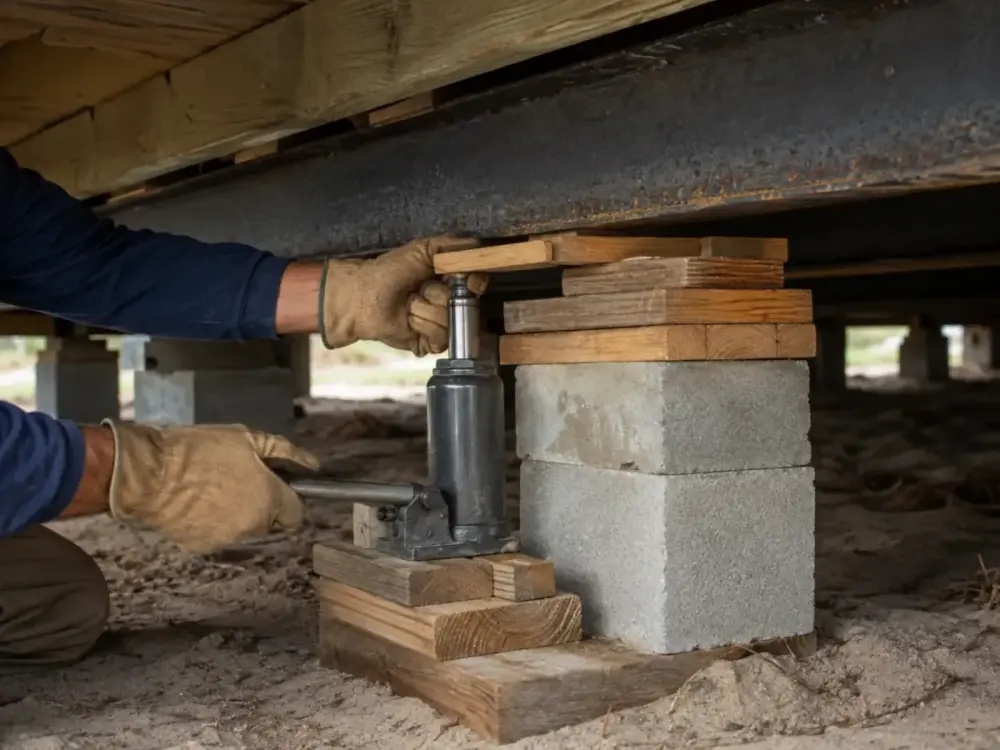
Releveling restores a flat, evenly supported steel chassis under a manufactured home after its piers have settled. Around Charleston the piers settle on a fairly predictable schedule, so this is the service most homes here need most often. Every pier gets mapped with a water level, the frame comes up on hydraulic jacks carried by solid cribbing, and every low pier is rebuilt back to tight contact with fresh hardwood shims. Singlewides are $450 to $800, doublewides $750 to $1,400, and nearly every home is finished in one day.
If doors have started dragging, a hallway has developed a lean, or the ceiling seam of a doublewide has opened up, this is the job that puts it right.
What being out of level actually does
A manufactured home is a steel frame with a box built on it. The frame is stiff, but it is not infinitely stiff, and when the piers under one section drop, the frame follows them down and twists. Everything attached to it goes along.
Door openings stop being rectangles, so doors rub at one corner, then refuse to latch. Windows bind in their tracks and occasionally crack at a corner. Drywall and panel joints open where the racking concentrates, most often above door openings. Floors develop a slope you feel before you see, and a bounce where the joists are no longer bearing the way they were designed to. On a doublewide, the two halves stop sitting at matched height and the seam down the center opens up at the ceiling or the floor.
None of that is cosmetic and none of it improves on its own. It is the house reporting on the ground underneath it.
How much is too much
The honest answer is that there is no code number for an existing home, so here is the working rule we use.
Under about half an inch of variation across the frame, with every door latching normally, is a watch-and-recheck situation. Recheck it next year and see whether it moved.
An inch or more, or any symptom you can feel underfoot, means book it. Settling is not linear and it is not self-limiting. A pier that has gone low is loaded off-center, so it grinds its own cap and shims progressively, and next summer it will be lower than it is now. The gap between a home that needs reshimming and a home that needs pier rebuilds is usually two or three deferred seasons and several hundred dollars.
Homes that are severely off, with visible leaning piers, straps hanging slack, or a marriage-line gap you can feel air through, are past the routine job and into pier rebuild territory. They still relevel. They just cost more than they would have.
The survey comes first, always
Skirting access panels come off and our crew goes under the home end to end. Every pier is shot with a water level off a datum point, usually the most stable pier on the home, and every reading is written down. A water level is a tube of water reading true elevation by physics rather than by battery, and off a single datum it tells you exactly which piers dropped and by how much: this one down three-quarters of an inch, this one an inch and five-eighths, these six true.
At the same time every pad, cap, and shim gets handled rather than glanced at, the vapor barrier gets looked at, and every anchor strap gets checked for tension and corrosion.
You get the map and a firm written price before a jack goes under anything. Anyone who quotes a relevel without doing this is quoting a guess, and guesses do not resolve in the homeowner’s favor.
The lift
Twenty-ton hydraulic bottle jacks go on solid wood cribbing at the frame, positioned near each low pier. There is one rule here that separates competent work from dangerous work: the load is carried by cribbing, never by a jack. A jack raises. Wood holds. Nobody works under a home supported by hydraulics.
Lifting happens in small increments, station to station along the frame, so the chassis returns toward plane as a whole rather than being pulled up at one point. Cranking a single station three inches in one motion is what cracks drywall, pops trim, and stresses plumbing connections. It is also faster, which is why cheap operators do it.
Rebuilding what the survey found
At each corrected pier: blocks re-stacked or replaced as needed, crushed or rotted caps and pads swapped out, and hardwood shims driven tight in opposing pairs between the cap and the beam.
The federal installation standards cap how much shim and lumber may sit on top of a pier. A pier that cannot reach the beam inside that allowance does not get a taller stack of wedges, it gets rebuilt at the correct height on a properly re-established footing. That is the honest boundary between a relevel and a repair, and it is priced separately and openly at $150 to $400 per pier rather than quietly absorbed or quietly skipped.
Verification, and why it is not optional
The entire frame gets re-shot with the water level after the work. Two things have to be true. Every pier must be carrying load, which you confirm by hand: a pier you can rattle is decorative, not structural, and a home can be perfectly level while standing on three piers that are doing nothing. And on a doublewide, both halves must read matched at the marriage line.
Then the straps get re-tensioned. This is not an upsell, it is mechanics. Straps were tightened against the home at whatever height it sat when they were installed, so raising the home changes their tension. A relevel that leaves the anchor system slack has finished half the job. If the anchors themselves are corroded, missing, or short of what the home’s size requires, that gets quoted separately on the tie-downs and anchors side rather than bundled in without telling you.
Doublewides and the center row
A singlewide sits on two frame rails with somewhere between twelve and twenty piers, and the geometry is simple.
A doublewide adds a third problem: the marriage line, the row of piers carrying the joined inner edges of both halves down the center of the home. That row has to come back up matched to both sections simultaneously. Bring one half up without the other and the seam stays stressed at the ceiling, the floor, and the roof connection. It is slower, more careful work, which is why the price and the hours are what they are.
The marriage-line gap is also the symptom owners most often live with, because it appears overhead rather than underfoot and looks like a trim problem. It is not. It is the center row sinking.
Why the interval is short in this part of the state
Homes on this ground generally need releveling every three to five years, and that is not a sales line, it is the maintenance cycle.
The reason is the ground. The coastal plain here is soft, low, and sitting over a shallow water table, so soil under a small concentrated footing is saturated for much of the year rather than occasionally. Saturated fine soil moves under sustained load. Low lots near creeks and marsh edges carry soft organic material that keeps consolidating for years after a home is set. Sandy ground drains at the surface and still squeezes sideways under a footing when it is wet through. Ground with more clay in it changes volume every time the moisture changes, which walks pads out of plane a little each season.
Then there is rainfall. The 1991 to 2020 climate normals for Charleston International Airport put annual precipitation at 52.51 inches, of which 25.79 inches, 49 percent of the year’s total, falls between June and September. August alone normals at 6.97 inches. Half a year’s water arrives in a third of the year, into ground that is already near saturation.
The outliers are what fill the schedule afterward. Tropical Storm Debby made its second landfall at Bulls Bay in August 2024 and dropped 12.84 inches on Charleston’s airport; the National Hurricane Center’s report on it records eastbound I-26 closed in Berkeley County, around thirty water rescues near Moncks Corner, and the Ashley River flooding Dorchester County roads and neighborhoods for roughly a week. Hurricane Matthew put 10.48 inches on the airport in October 2016 and the same agency names Berkeley, Charleston, and Dorchester among the hardest-hit counties. Ground that stays saturated for a week is ground that lets footings move, and the sticking-door calls arrive a season or two behind the storm.
Homes on high, well-drained, prepared pads get the long end of the interval. Homes in the low flat country around Summerville and the creek bottoms in Goose Creek get the short end. Anybody promising a permanent relevel on this soil either has not worked here or is counting on you not knowing.
What it costs
| Situation | Expect |
|---|---|
| Routine relevel, piers reshimmed | $450-$800 single / $750-$1,400 double |
| Plus piers needing a reset | +$75-$150 per pier |
| Plus piers needing a full rebuild | +$150-$400 per pier |
| Severely settled, poor access, standing water | quoted after the survey |
The full tables, including anchors, belly, skirting, and setup work, are on the pricing page. Every figure is confirmed in writing the same day the survey is done, because by then there is nothing left to discover.
Homes that were moved recently settle fastest
Worth calling out on its own, because it surprises people. The homes most badly out of level are frequently not the oldest ones, they are the ones set on new ground in the last few years by a mover who put piers directly onto soil nobody graded or compacted.
Fresh footings on unprepared ground consolidate hard through their first few wet seasons and they do it unevenly. If your home was set recently and the doors already stick, the relevel is routine but the conversation should include the pad, because an unprepared pad keeps moving no matter how well the piers are built on it. That is why pad preparation should appear as its own visible line item on any transport and setup quote.
Stretching the interval
A relevel corrects the elevation. It does not change the soil. Three things reliably lengthen the cycle on this ground:
Keep water moving away from the pier lines. Gutters that discharge next to the home, a yard that grades toward the crawl space, or a driveway that sheets runoff underneath will keep the ground under the footings saturated no matter what is built on it.
Keep the crawl space ventilated. Blocked or crushed skirting vents trap moisture against wood caps and shims and soften them, which shortens the interval quietly. See skirting repair.
Fix pad problems when the report flags them rather than reshimming over them for another cycle.
Owners who do those three routinely get the long end of the three to five years. Either way, the periodic check costs nothing and beats waiting for the doors to tell you.
Get the free level check
Tell us the size of the home, roughly when it was built, where it sits, and what you are noticing. Our crew picks it up from there, shoots every pier, and hands you a written price the same visit. We cover Summerville, Moncks Corner, Goose Creek, North Charleston, Walterboro, and St. George. Whether you found this searching for releveling near you from a park lot on US-52 or from a family place on a dirt road in Colleton County, the free survey is the same next step.
Frequently Asked Questions
What is the price for a relevel here?
Singlewides are $450 to $800 and doublewides $750 to $1,400. That includes the pier survey, the lift, new hardwood shims, crushed caps replaced, and straps brought back to tension. Homes that need piers rebuilt rather than reset cost more, priced per pier before anything starts, and the survey itself is free.
Is my house going to be sitting on jacks all day?
Not the way people imagine it. The frame moves in small increments at several stations at once, and the load rides on solid cribbing rather than on a jack. A singlewide is three to five hours start to finish and a doublewide six to eight, and you can stay in the home while it happens.
Can releveling crack my walls?
A careful one prevents cracking. Damage comes from lifting one point a long way in one go with a single jack, which racks the frame. Working small increments across the whole chassis moves the home back as a unit. On a house that sat badly settled for years, some existing cracks will close and occasionally a hidden one shows itself, which is the settling revealing what it already did.
What reading means I should book it rather than wait?
There is no legal threshold, but a working rule: under half an inch across the frame with everything still latching is a watch-and-recheck situation. An inch or more, or any symptom you can feel walking the hallway, means schedule it. Settling compounds, and a low pier keeps grinding its own cap and shims until it needs rebuilding.
Do you work in parks as well as on private land?
Both, and it is the same process either way. In land-lease communities we coordinate with management where the park requires it. On owned land, any scope that triggers a permit runs through the permitting office for Berkeley, Charleston, Dorchester, or Colleton County depending on where the home sits.
More mobilehome services
- Pier & Pad Repair for Mobile Homes in the Charleston Area
- Tie-Downs & Ground Anchors for Lowcountry Mobile Homes
- Vapor Barrier Repair & Replacement in the Charleston Area
- Mobile Home Skirting Repair & Replacement in the Charleston Area
- Pre-Sale Leveling Inspection for Mobile Homes in the Charleston Area
- Mobile Home Transport & Setup in the Charleston Area
- Utility Hookups for Newly Set Mobile Homes in the Charleston Area