 Charleston Mobile Home Leveling
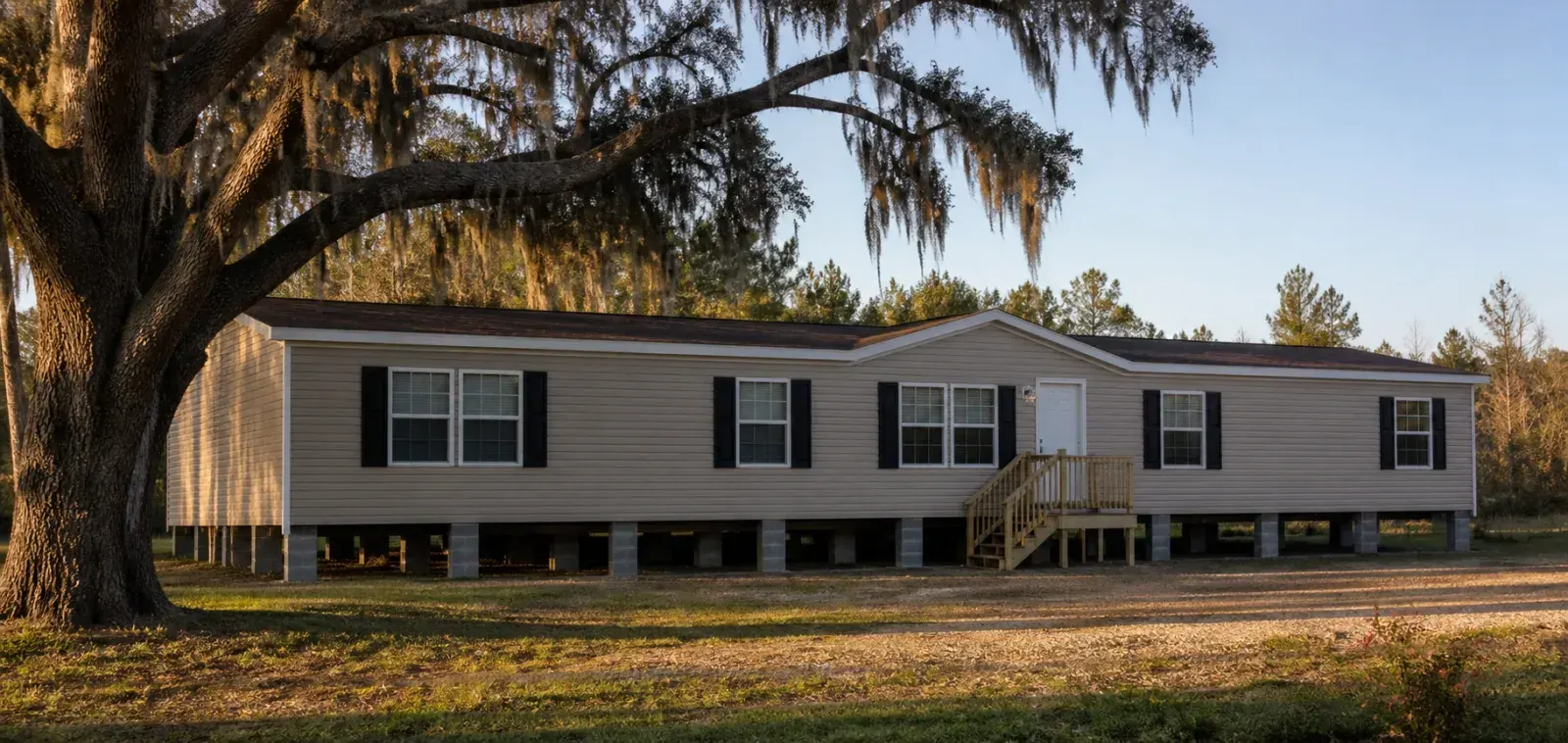
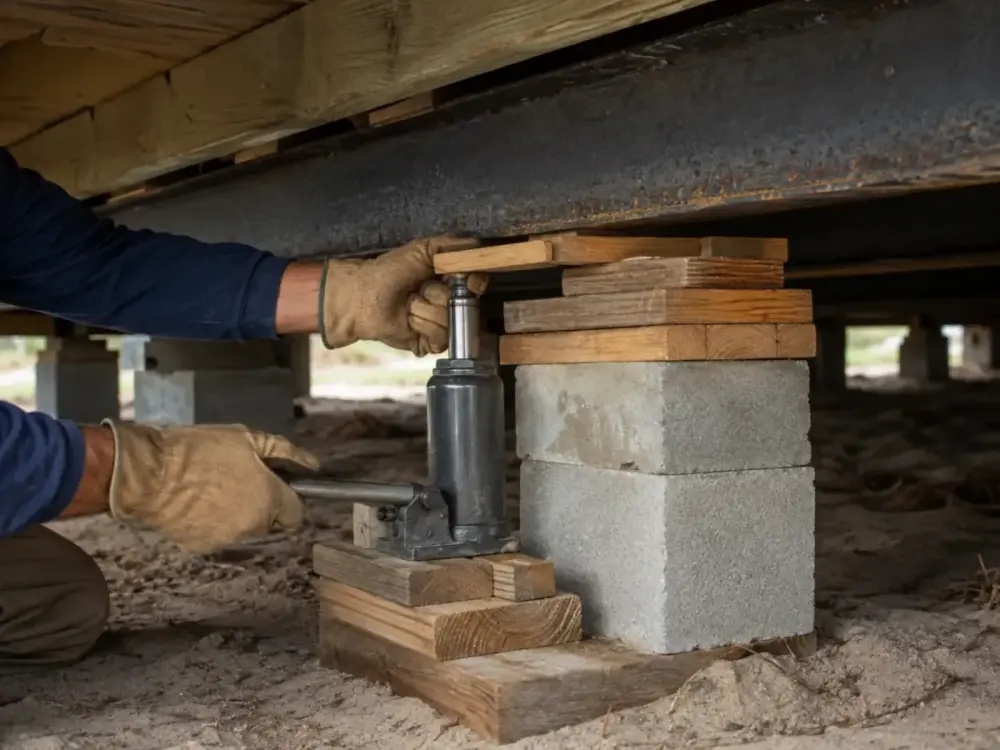
Charleston Mobile Home Leveling puts settled manufactured homes across four Lowcountry counties back on the level line. We map every pier with a water level, the frame comes up on hydraulic jacks carried by solid cribbing, and each low pier is rebuilt with fresh hardwood shims until the whole chassis reads flat again. A singlewide relevel is $450 to $800 and a doublewide $750 to $1,400. The survey that tells you exactly what your home needs costs nothing.
Sticking doors, a floor with a lean in it, a ceiling seam that has opened up on a doublewide: those are the reasons people call, and they all come from the same place.
The ground is the reason
Manufactured housing is a large part of how the Lowcountry actually lives once you leave the peninsula. Berkeley and Dorchester have been among the fastest-growing counties in South Carolina for years, and much of that growth landed on owned land and in parks along US-17A, US-176, US-52, and the roads feeding Lake Moultrie. Colleton County is manufactured-home country from Walterboro out through Cottageville. Almost all of it sits on the same difficult ground.
A manufactured home concentrates its entire weight through a few dozen small footings. South Carolina’s installation standard, Regulation 79-42, sets the minimum footing at 144 square inches on soil bearing at least 1,000 pounds per square foot. That is one square foot of contact per pier, pressed into some of the wettest ground in the state. Working from the USDA Natural Resources Conservation Service soil survey, 55.4 percent of the Charleston County survey area is mapped as poorly or very poorly drained, along with 54.3 percent of Colleton County, 51.1 percent of Dorchester, and 36.7 percent of Berkeley. Those are not opinions about the neighborhood. They are the published drainage classes of the soils people set homes on.
The soil series names are worth knowing. Yonges, one of the largest components of the Charleston County survey, carries free water within ten inches of the surface for about six months of the year. Meggett, the single largest soil in Berkeley County, sits with its water table between the surface and twelve inches from November through April and is rated by NRCS as having moderate shrink-swell potential, meaning it changes volume as it wets and dries. Rutlege holds water within six inches of the surface from December into May. NRCS rates every one of those, along with Wadmalaw, Wahee, Yemassee, and Cape Fear, as very limited for dwellings without basements, and the limiting factor it names first is depth to the saturated zone.
Then there is the marsh. Bohicket and Capers, the tidal soils that people around here call pluff mud, cover roughly 22.9 percent of the Charleston County survey area between them. The USDA series description for Bohicket records an n-value of 1 or more through the entire ten to forty inch control section, which is the formal soil-science way of saying the material flows out of a closed fist when you squeeze it. It is flooded twice daily by seawater and permanently saturated. Nobody sets a home on open marsh, but plenty of homes sit on ground that grades into it, was filled over it, or sits a few feet above it, and that transition is where footings do their worst work.
And then it rains. Charleston International Airport’s 1991 to 2020 climate normals put annual precipitation at 52.51 inches, of which 25.79 inches, 49 percent of the year’s rain, falls in June through September. August alone normals at 6.97 inches. Nearly half the year’s water arrives in a third of the year, into soil that is already saturated for months at a stretch.
The upshot is a maintenance interval rather than a repair. Homes on this ground generally need releveling every three to five years. That is not a sales line; it falls straight out of the soil survey and the rain record above.
What settling looks like from inside the house
You almost never notice it by looking at the home from the yard. You notice it living in it.
- Doors rub, then drag, then stop latching. The frame has racked, so the opening is no longer a rectangle.
- Windows bind in their tracks, and occasionally crack at a corner.
- Floors slope or feel bouncy. Put a marble down. If it travels, you are not imagining it.
- Cracks open at wall and ceiling joints, most often above doorways where the racking concentrates.
- A doublewide’s marriage line opens up. The seam down the center separates at the ceiling or floor because the two halves are no longer at matched height. Owners live with this one longest because it is overhead rather than underfoot.
- Skirting bows or pulls away as the home descends onto panels that were never meant to carry weight.
Any of those earns a free level check. Settling compounds: a pier that is an inch low now is grinding its own cap and shims, and it will be lower after next summer. Caught early it is a straightforward relevel. Left for a few more seasons it becomes pier rebuilds, and the difference on the invoice is measured in hundreds of dollars.
What a relevel involves
The survey. Access panels off, crew under the home end to end, every pier shot with a water level off a datum point. You end up with a number per pier rather than an opinion. Pads, caps, and shims get handled rather than glanced at, the belly gets checked, and every anchor strap gets looked at for tension and rust. The written price comes out of this, before anything is lifted.
The lift. Twenty-ton bottle jacks on solid wood cribbing at the frame near each low pier, working in small increments across multiple stations so the chassis returns toward plane as a unit. The rule that separates competent work from dangerous work is simple: the cribbing carries the load, never the jack.
The pier work. Blocks re-stacked or replaced, crushed caps and pads swapped out, hardwood shims driven tight in opposing pairs. Federal installation standards limit how much shim and lumber may sit on top of a pier, so a pier that cannot reach the beam inside that allowance gets rebuilt at the right height instead of stacked taller. That is priced separately and openly.
The verification. The frame is re-shot end to end. Every pier has to be carrying load, which you confirm by hand, because a home can read perfectly level while standing on piers that are doing nothing. On a doublewide, both halves have to read matched at the center row.
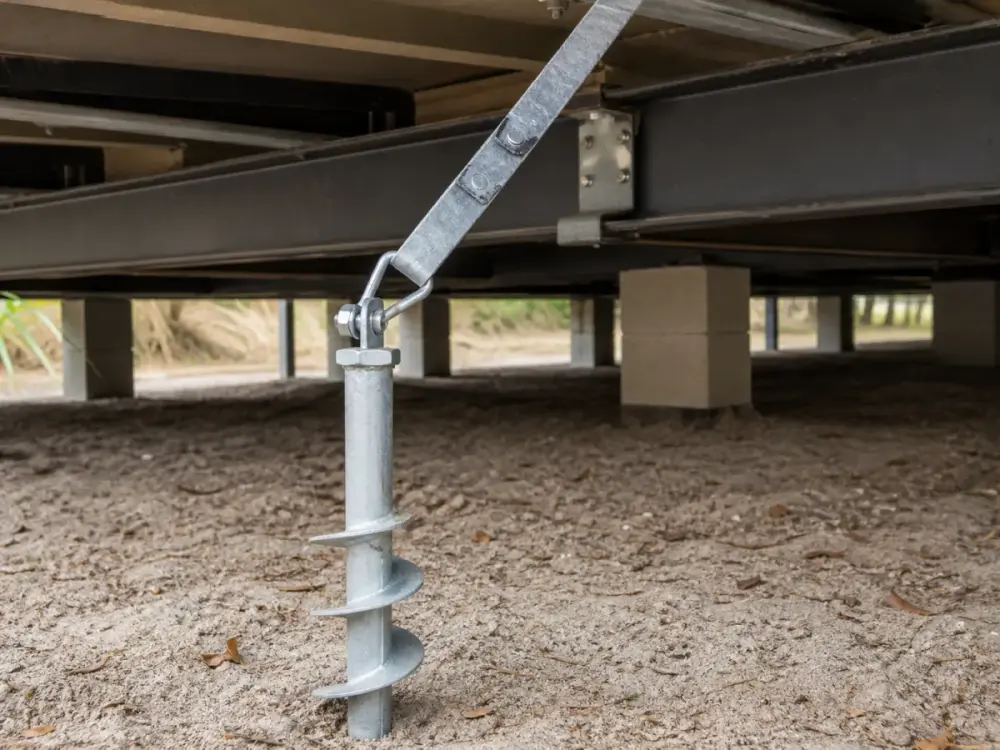
The straps. Anchor straps get re-tensioned, because raising the home changes tension they were set at. If the anchor system itself is short, corroded, or predates modern wind standards, you should be told, and it should be quoted separately rather than quietly added.
Every service covered here
- Mobile home leveling. The core service. Survey, lift, shims, whole-frame verification, most homes in a day.
- Pier and pad repair. Reset, reshim, or fully rebuild settled piers and the footings under them. $75 to $150 a pier to reset, $150 to $400 to rebuild.
- Tie-downs and anchors. Install, replace, and re-tension ground anchors and straps. The federal standard at 24 CFR 3280.305 names Berkeley, Charleston, Colleton, and Dorchester in HUD Wind Zone II by name, designed against a 100 mph wind, and plenty of older systems around here are nowhere near it.
- Vapor barrier replacement. Repair or replace the sealed underbelly that keeps ground moisture out of your insulation and subfloor. On this water table an open belly is a countdown.
- Skirting repair. Panels, vents, and access doors, including the storm damage that arrives every summer.
- Pre-sale leveling inspection. A written level, support, and anchoring report for parks, lenders, insurers, and buyers. $150 to $350, usually credited toward any work it finds.
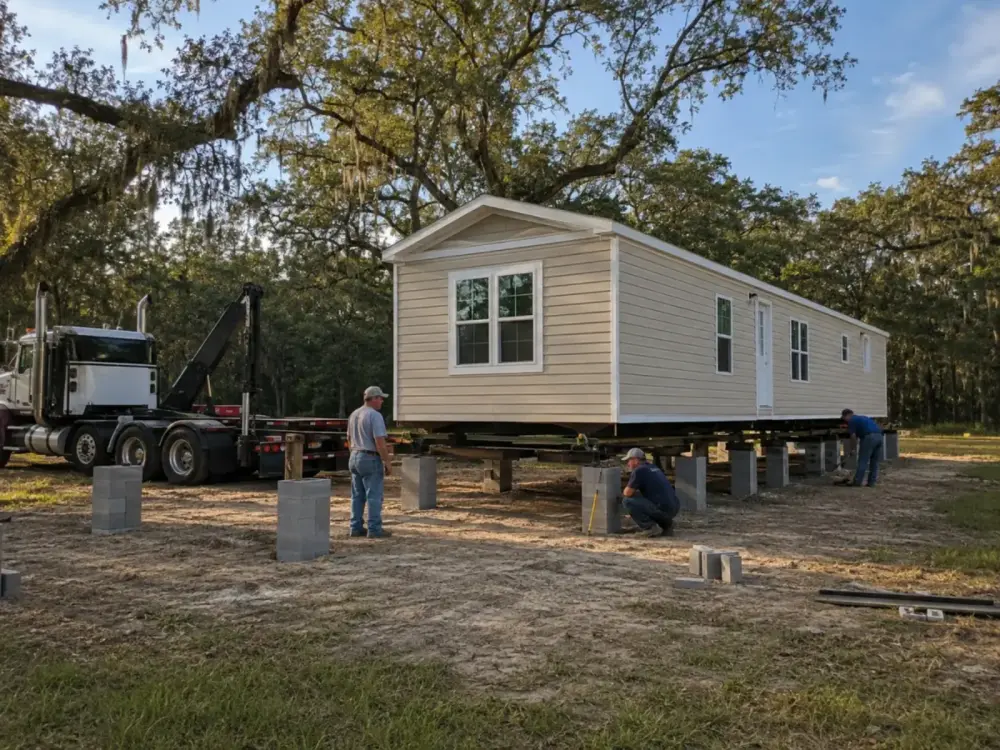
- Mobile home transport and setup. Full pull-and-set with permits handled, itemized from a site visit.
- Utility hookups. Water, sewer or septic, electrical, and HVAC on a newly set home, sequenced so the final inspection passes the first time.
The rates, published
Almost nobody in this trade will give you a number before they are standing in your yard. These ranges have been on this website since it went up.
| Service | Typical range |
|---|---|
| Relevel, singlewide | $450-$800 |
| Relevel, doublewide | $750-$1,400 |
| Pier reset or reshim | $75-$150 per pier |
| Pier rebuild | $150-$400 per pier |
| Anchors and tie-downs | $600-$3,500 |
| Vapor barrier | $300-$800 patch, $1,200-$4,500 full |
| Skirting | $200-$800 repair, $900-$2,500 full |
| Pre-sale inspection | $150-$350 |
| Transport and setup | $5,000-$8,000 single, $8,000-$15,000 double, itemized |
| Utility hookups | per connection, see pricing |
A leveling job should start with the free survey and end with a firm written number. Measured against what deferral costs, leveling stays the affordable end of structural work: a few hundred dollars on a normal cycle instead of the pier rebuilds, rotted subfloor, and racked door frames that accumulate when settling runs unwatched for a decade. Full detail and what pushes a job inside its range is on the pricing page.
Flood zones change the job here, and the rules are specific
This is the part of the Lowcountry picture that has no equivalent inland, and it is worth knowing before you buy, move, or set a home.
Charleston County’s floodplain rules live in Chapter 9 of the county code, “Flood Damage Prevention and Protection,” which was rewritten in 2020 (Ordinance 2124), last amended by Ordinance 2306 in August 2024, and runs off the county Flood Insurance Study and FIRMs dated January 29, 2021. Three provisions matter most to a manufactured home owner.
Freeboard is two feet. The county’s design flood elevation is the base flood elevation plus two feet, not the base flood elevation alone. Berkeley County publishes the same two-foot freeboard requirement.
In A and AE zones, the frame goes up on an engineered permanent foundation. Section 9-40(j)(2) requires manufactured homes to be installed using methods that minimize flood damage, including elevating the frame on a permanent foundation to or above the design flood elevation in A or AE zones, anchored to resist flotation, collapse, and lateral movement, and the ordinance is explicit that this is in addition to the state and local wind anchoring requirements rather than instead of them. A “manufactured home permanent foundation” is defined in the ordinance as one designed by a professional engineer registered in South Carolina and approved by the building official, with bolt-on and bolt-off systems accepted in a manufactured home park.
In VE and Coastal A zones, new homes are not placed at all. Section 9-42(d)(1) states that new or replacement manufactured homes shall not be placed on property in VE and Coastal A zones. Homes already there may remain if they meet minimum health and safety standards and are anchored against flotation, collapse, lateral movement, and debris impact. Charleston County also holds Coastal A areas to the same construction standards as V and VE zones, which is a deliberate choice tied to its Community Rating System score.
Two practical consequences follow. Homes in flood zones frequently sit high on tall pier stacks, and tall piers behave differently as they age, which the pier and pad repair page covers. And an elevation certificate, prepared by a registered surveyor or engineer, gates the inspections: the county states that no final inspection occurs without an approved finished-construction elevation certificate on file. Berkeley County applies the same rule, and will not release power to the home without it.
None of that changes a routine relevel of a home already sitting where it sits. All of it changes a set, a move, or a foundation rebuild, which is why those are quoted from a site visit rather than a table.
Wind, and the reason anchors matter more here
Hugo came ashore at Sullivan’s Island at midnight on September 22, 1989 as a Category 4. The National Weather Service office in Charleston puts the winds at 135 to 140 mph, and the peak storm tide at Bulls Bay reached 19.8 feet above mean sea level, the highest ever recorded on the United States East Coast. Downtown Charleston gusted to 108 mph and the airport to 98. Inland, the storm felled over a billion board-feet of timber in the Francis Marion National Forest, roughly 70 percent of its lumber-quality trees, which is what hurricane-force wind fifty miles from the beach actually looks like.
For a site-built house, wind resistance is built into the structure. For a manufactured home it is almost entirely the anchoring system, and that system degrades without announcing itself. Straps go slack every time the home settles, which on this ground is continuously. Anchor shafts corrode below grade where nobody sees them. Homes predating HUD’s July 1994 wind-standard revision, a large share of the older park stock along US-52 and US-78, were anchored to a weaker rule than the zone calls for now.
Which is why leveling and tie-down work are one conversation here rather than two, and why strap re-tension should come with every relevel by default.
Who is allowed to do this work
South Carolina Code § 40-29-30(A) says it plainly: no manufactured home installer may install manufactured housing without being licensed by the Manufactured Housing Board. And § 40-29-20(8) defines installing broadly, as “the operations performed at the occupancy site which render a manufactured home fit for habitation,” including positioning, blocking, leveling, supporting, tying down, and connecting utility systems. The South Carolina Building Codes Council has issued a notice to building officials saying the same thing. Releveling your home is licensed installer work under state law, not handyman work.
Licensees get there by way of two years of experience, board-approved training, and a passing exam grade, post a $5,000 surety bond, renew on a two-year cycle, and carry continuing education. Separately, state law at § 31-17-360 requires a moving permit before a home is relocated, conditioned on a county treasurer certificate showing no unpaid taxes, and § 31-17-320 requires a county decal within fifteen days of bringing a home into the state or moving one between counties.
We bring all that up unprompted because it protects you. Ask every installer for a licence number and proof of insurance, us included, and pay attention to who gets quiet.
Where the service reaches
The service covers four counties out of the Charleston area: Summerville and the I-26 corridor down through North Charleston, Goose Creek and the US-52 corridor up to Moncks Corner and the Lake Moultrie communities, St. George and upper Dorchester along US-78 and US-15, and Walterboro, Cottageville, and rural Colleton County out along US-17A and I-95.
Book the free level check
Tell us what you are noticing, a door that will not close, a hallway with a lean, a seam that has opened, along with the home’s size and where it sits, and we will set up your free level check. We shoot every pier and write the price at the home while the readings are fresh, so expect a pier-by-pier map, a firm number, and a straight answer about what needs doing now versus what can honestly wait. Questions first? The FAQ covers most of them, or read about us.